The carbon footprint analysis vs. compatibility with a low-carbon future
By performing a carbon footprint analysis, companies must consider 3 types of emissions (scopes). Scope 1 corresponds to direct emissions (chemical processes during manufacturing, gas leaks,…), scope 2 is about the emissions linked to electricity consumption, and lastly, scope 3 covers all indirect emissions (daily commute of employees, supply of raw materials, end of life management of products,…).
In contrast, the idea of a low-carbon future describes the concept of a world in which humanity emits no more greenhouse gases than what can be sequestrated on a global level. This means: (almost) no use of petrol, coal and natural gas for the production of energy, (almost) no chemical processes that emit greenhouse gases, like the manufacturing of concrete or the fertilization of plants with nitrogen, etc.
The carbon footprint analysis measures the activity of a company, including the production of, but not the use of its products and services. As a consequence, the carbon footprint analysis offers a partial vision of the compatibility of a company with a low-carbon future. Thus, a company can have a small carbon footprint, but manufacture products that:
- Generale a lot of emissions – for example petrol-powered cars,
- Are used by / enable an industry that pollutes a lot – for example equipment for fossil oil extraction,
- Incentivize a change in behavior – for example: a supermarket replaces its store in the city by one located in the suburbs. The new building generates less emissions, but its location incentivizes people to take their car to get to the store.
In all 3 cases, the opposite is also possible: for example the creation of a video call app can increase the carbon footprint of the company in question. However, such an app can reduce the number of plane travel for professional meetings. This corresponds thus to the 3rd case cited above, but with the opposite result.
Why care about the compatibility with a low-carbon future?
In theory, if every company on Earth and every individual reduces their carbon footprint, this will automatically create a low-carbon future. Why is it necessary for a company to go further?
If a company does not take into account the use of its products and services and their impact on society’s behavior, they risk being replaced by competitors who will offer products and services better suited to their customers’ desire to reduce their carbon footprint.
As a result, companies are obliged to consider this aspect simply to ensure that their products and services will still be in demand in the future.
How to evaluate compatibility with a low-carbon future? The example of a space mission
Alcimed worked with Carbone4 and Ekodev to help the European Space Agency (ESA) establish a methodology for assessing the indirect emissions of a space mission. This methodology was based on the use case of precision agriculture (“Variable Rate Application” or “VRA”):
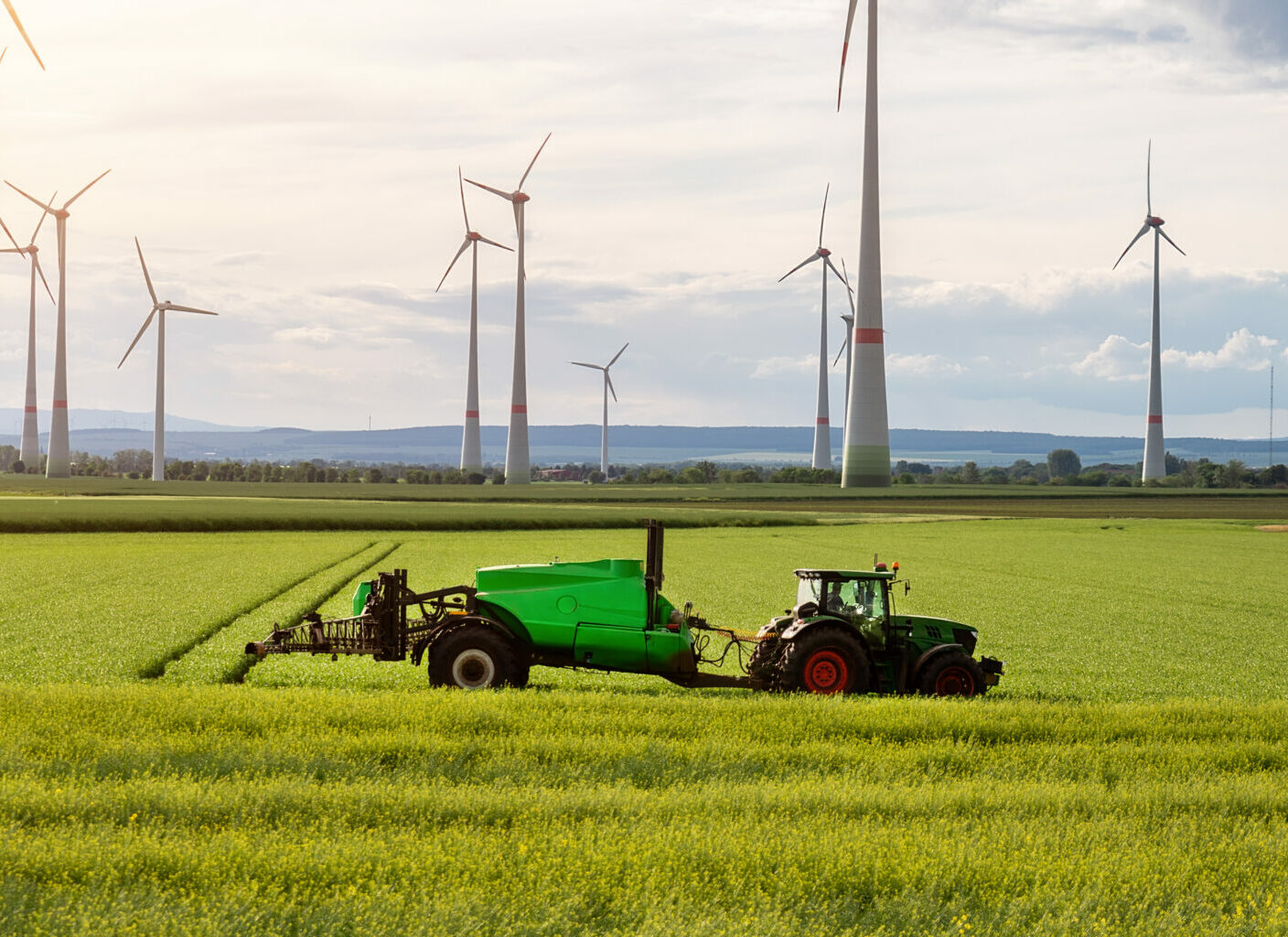
Indeed, a satellite produces a significant amount of greenhouse gas emissions during its production, launch and operation. On the other hand, satellite data can be used to reduce emissions in other applications. In agriculture, for example, the data can help farmers to perform VRA, i.e. to better dose the quantities of inputs (fertilizers, water), enabling them to reduce their direct and indirect emissions. This is a practice already used by some farmers.
In order to quantify these aspects, one must follow 3 main steps:
- Compare the current emissions of the application in question (agriculture), with the emissions the application would emit in a fictitious scenario in which the solution (VRA) does not exist: “how much does agriculture emit now?” and “how much would agriculture emit if VRA did not exist?”
- Identify the entire value chain of the solution (VRA) and identify the contributions of each player: “what are all the bricks (satellite, computer, tractor, etc.) that make up VRA?” and “what is the role of each brick?
- Analyze the contribution of your product to the solution and to the emissions induced or avoided: “How important is the contribution of Space Missions and their segments in VRA?
It is worth mentioning that there are standards for assessing contributions to avoided emissions. In this article, however, we focus on the qualitative aspects of compatibility with a low-carbon future. Clearly, such an exercise requires considerable investigation. Indeed, the amount of information and data required, and the difficulty of accessing it, means that the associated effort is high. In our example, it was necessary to understand the practices of precision agriculture and to estimate the emissions linked to “conventional” and “precision” agriculture worldwide.
As explained above, however, it is necessary to carry out this research in order to make the right strategic decisions. Despite the very preliminary methodology and the high level of uncertainty in the calculations at this stage, this study has shown the following:
The avoided emissions thanks to precision farming enabled by Space Missions are much greater than the amount of emissions induced by a satellite program and the other contributors to the solution (drones, data centers, etc.).
It’s important to look beyond your carbon footprint when making strategic decisions about sustainable development. We need to assess the impact of our products and services, and their compatibility with a future low-carbon future. This requires a great deal of investigation and gathering of diffuse information to gain a detailed understanding of usage, but this effort is necessary in order to make the right strategic decisions and implement the right actions.
With over 30 years of experience in investigating and exploring uncharted territory, Alcimed is a particularly relevant partner to support you in this process, where understanding the needs of end-users/application sectors is key to providing a consensual vision of companies’ strategic sustainable development axes. Don’t hesitate to contact our team!
About the author,
Steffen, Project Manager within Alcimed’s Aeronautics-Space-Defence team in France.